
You’re in the middle of a meeting, asleep, or just standing in line at the grocery store, and suddenly heat floods through your chest and face. Your skin flushes. You start sweating. A minute or two later, it passes. Sometimes it leaves you feeling chilled afterward, as if your body swung too far in the other direction while cooling back down.
If this is a regular part of your life right now, you’re not alone. Hot flashes affect up to 80 percent of women during the menopause transition, making them the most common and often the most disruptive symptom of perimenopause. But despite how common they are, many women never get a straightforward answer for what’s happening in their body when a hot flash hits. Understanding the mechanism replaces confusion and frustration with a clear, physiological explanation. That shift changes what you do next, even if it doesn’t make the hot flash itself more comfortable in the moment.
Hot Flashes Are Not Just a Stress Reaction
Before getting into the mechanism, it helps to name what a hot flash isn’t. It isn’t a side effect of being stressed and anxious. It results from a physiological disruption triggered by falling estrogen levels and is a measurable chain of events in the brain and body.
It’s also one visible piece of a broader hormonal shift that perimenopause can create, alongside changes in sleep, mood, weight, and energy that are often treated as separate problems instead of one connected picture.
The Six-Step Process Behind Every Hot Flash
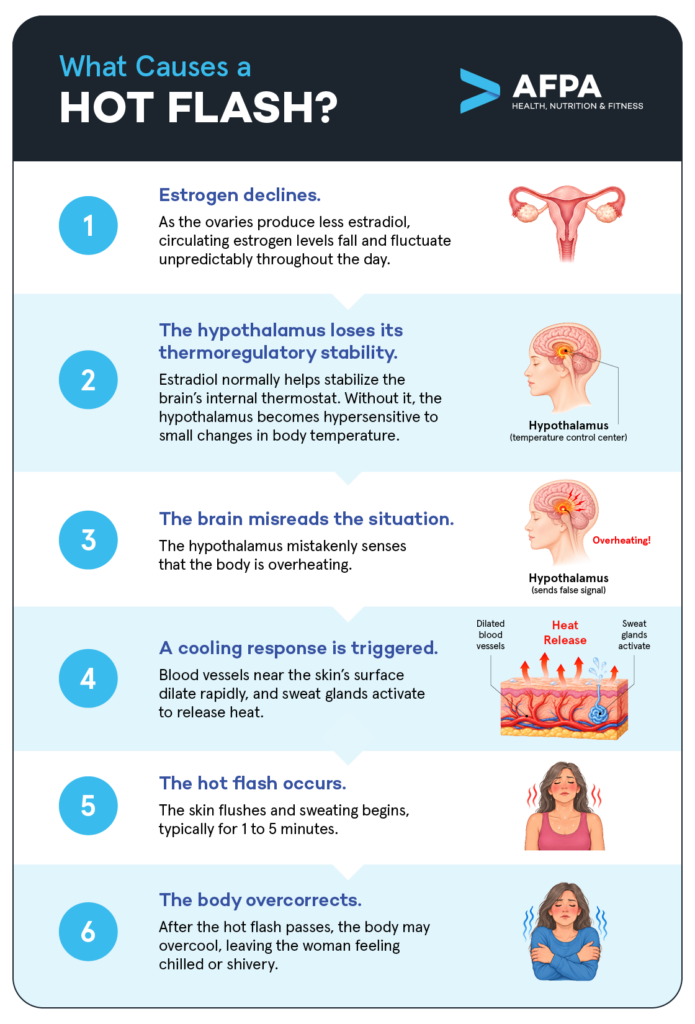
Here’s what’s happening, step-by-step:
- Estrogen declines. As the ovaries produce less estradiol, the most potent form of estrogen, circulating estrogen levels fall and fluctuate throughout the day. The underlying hormonal signals spike and dip erratically, so the decline itself is anything but smooth or steady.
- The hypothalamus loses its thermoregulatory stability. Estradiol normally helps stabilize the brain’s internal thermostat, located in a region called the hypothalamus. Without adequate estradiol, the hypothalamus becomes hypersensitive to even small changes in body temperature.
- The brain misreads the situation. The hypothalamus mistakenly senses that the body is overheating, even when it isn’t. This is the core of the malfunction: A normal, stable body temperature is misread, and the hypothalamus signals to correct it.
- A cooling response is triggered. In response, blood vessels near the skin’s surface dilate rapidly, and sweat glands activate to release heat. This is the body’s standard cooling mechanism, just triggered at the wrong moment.
- The hot flash occurs. The skin flushes and sweating begins, typically lasting one to five minutes. When this happens during sleep, it’s called a night sweat, and it’s the same mechanism, with the added disruption of waking you up.
The body overcorrects. After the hot flash passes, the body may overcool in response to the rapid heat loss, leaving you feeling chilled or shivery in the aftermath. That’s why a hot flash can end with you reaching for a blanket minutes after throwing off the covers.
Why This Happens to Some Women More Than Others
Hot flash experiences vary enormously. Some women have occasional, mild episodes, while others have seven or more a day. Vasomotor symptoms (the clinical term for hot flashes and night sweats) can also start earlier and last longer for some groups of women than others. Individual bodies respond differently to the same underlying hormonal shift, and how long or how intensely someone experiences that shift comes down to biology.
Hot flashes also aren’t guaranteed to disappear the moment menstruation stops. For some women, they persist well into postmenopause because the body is still adjusting to lower, steadier hormone levels.
What the Evidence Supports for Managing Them
Once you understand that hot flashes are a thermoregulation problem, not a stress problem, it’s easier to make sense of why certain strategies help and others don’t.
Menopause hormone therapy (MHT) is an effective, evidence-based option specifically approved for treating vasomotor symptoms. For many women, it meaningfully improves quality of life. That decision belongs to you and a healthcare provider, weighed against your individual health history rather than pieced together from general advice you’ve read online.
Beyond MHT, a few other strategies are backed by evidence:
- Resistance training may help reduce hot flash frequency.
- Regular physical activity in general supports symptom management.
- Weight management is associated with reduced frequency and severity for women carrying excess weight.
- Soy foods containing isoflavones (about 50 to 60 milligrams per day) may reduce hot flash frequency for some.
“I wish that women knew how establishing healthy lifestyle habits in your 30s and 40s may help you avoid hot flashes. Those habits include weight management, limiting caffeine, consuming very little alcohol, and eating about two servings of soy every day. There’s no guarantee that these habits will help you avoid hot flashes, but research points to an association between these practices and fewer hot flashes.” — Elizabeth Ward, MS, RDN
What doesn’t have solid evidence are dietary supplements marketed specifically for hot flash relief. Herbs and botanicals are not standardized the way medications are, and the research base for most of these products simply isn’t there yet. The evidence hasn’t caught up to the marketing. Treat any supplement or product promising dramatic, guaranteed relief with skepticism.
The Bigger Picture
Frequent or persistent hot flashes are also associated with elevated cardiovascular risk factors, such as higher blood pressure, elevated cholesterol, and insulin resistance. This doesn’t mean every woman with hot flashes will develop heart disease. Frequent vasomotor symptoms are a signal to bring cardiovascular prevention into the conversation alongside whatever strategy you’re using to manage the hot flashes themselves.
Pro Tip from Elizabeth Ward, MS, RDN — “I can’t say enough about letting your primary doctor know about your hot flashes and the fact that you know they’re associated with a greater risk for heart disease. You should expect your doctor to monitor closely all the other risk factors for heart disease, including LDL cholesterol, blood glucose levels, and blood pressure.”
Understanding Your Body Is the Starting Point
Knowing the mechanism turns a confusing, sometimes embarrassing symptom into something that can be explained and grounded in clear physiology with concrete options for managing it.
That same principle, replacing vague explanations with actual insight into what’s happening in the body, is the foundation of the Perimenopause Whole-Health Specialist Certificate course. It goes beyond hot flashes to encompass the full range of physiological, nutritional, and lifestyle shifts that occur during this transition, giving you a structured way to understand your own experience or to support other women navigating theirs.
Explore the course to build a deeper, evidence-based understanding of what’s happening during perimenopause and why it matters for whole-health support.
Enroll in the Perimenopause Whole-Health Specialist Certificate course to build the structured foundation this work requires.
Common Questions
Are hot flash supplements ever worth trying?
Most dietary supplements marketed for hot flashes don’t yet have strong evidence behind them. If you’re considering one, discuss it with your doctor first, both for safety and to set realistic expectations.
Do hot flashes mean menopause is near?
Not necessarily. Hot flashes can start years before your menstrual cycle stops, during early perimenopause. Their presence doesn’t reliably predict how close you are to your final menstrual cycle.
How much soy would I actually need to eat to lessen my hot flashes?
Roughly 50 to 60 milligrams of isoflavones per day is the threshold associated with some benefit. For reference, a quarter cup of roasted soybeans provides around 78 milligrams, and a cup or more of soy milk can also get you into range.
This article is intended for educational purposes and is not a substitute for personalized medical advice. A qualified healthcare provider can help you evaluate which options are appropriate for your health history.
References:
- https://menopause.org/wp-content/uploads/professional/2023-nonhormone-therapy-position-statement.pdf

Want to be the Go-To Expert for Women Navigating Perimenopause?
AFPA’s Perimenopause Whole-Health Specialist Certificate program gives you the integrative knowledge and practical training to guide women through one of the most significant health transitions of their lives.